1. Executive Summary:
The worldwide second-opinion market is experiencing advanced growth, driven by innovations in telemedicine, improved patient awareness, and the rising incidence of chronic diseases. The necessity for a second opinion has increased as patients look to confirm diagnosis and explore treatment choices.
2.Introduction:
A second opinion is the independent evaluation of a medical condition performed by a healthcare professional in addition to an initial medical diagnosis. (1)
Patients who face complicated treatment interventions, chronic diseases, or uncertainties usually seek a second opinion.
Benefits:
Enhanced accuracy: Second opinions can provide a more accurate diagnosis of a specific condition. According to the study at the Mayo Clinic, 21% of the patients obtained a new diagnosis after seeking a second opinion, while 66% had their initial diagnosis improved.(2)
Consulting a different healthcare professional can provide more effective treatment strategies.
A second opinion can boost the patient's confidence, reduce fear, and provide reassurance to make informed decisions about their health.
Impact on healthcare costs and clinical outcomes:
Getting a second opinion can help cut down on treatments that aren’t necessary and the costs that come with them. This can improve clinical outcomes by forcing effective treatment plans that are tailored to each person’s needs
3. Market overview:
The global medical second opinion market is projected at USD 7.12 billion in 2024 and is expected to rise to USD 20.45 billion by 2031 at a CAGR of 16.3% from 2024–2031. (3)

The global medical second opinion market, based on data from Coherent Market Insights Inc., is estimated to be USD 7.12 billion in 2024 and is expected to grow to USD 20.45 billion with a compound annual growth rate (CAGR) of 16.3% during this period.
Market Trends:
- Increasing demand for evidence-based medical opinions: Patients are increasingly seeking personalised medical guidance that closely aligns with their health profiles. This trend is driven by the demand for precise diagnosis and effective treatment strategies.
- Post-COVID-19, there has been an increase in the number of telemedicine consultations for second opinions. Healthcare professionals are available for remote virtual consultations through telemedicine platforms, which reveals that telemedicine is comfortable for both patients and physicians. As the patient’s medical records are maintained, doctors can easily access the previous diagnostic findings. This feature helps review the medical history and treatment strategies. The use of telemedicine and virtual platforms is becoming popular in the market for obtaining a second medical opinion. Major businesses are providing virtual second opinion services through online platforms to expand their reach and services. For instance, Grand Rounds uses video conferencing with medical experts and telemedicine technologies to offer virtual medical second opinions. These virtual consultations enable people to seek professional advice without the need to travel.
- A notable trend in the market for medical second opinions is the integration of machine learning and artificial intelligence. AI techniques analyse large medical datasets and enhance clinical decision-making, thereby enhancing second views. They propose differential diagnosis and help sort medical histories and diagnostic tests. In a large survey conducted in the United States, more than half of the American adults put their health information into a large language model (LLM) (4) For instance, consider the case of a mother who, after consulting 17 doctors and failing to receive a diagnosis for her son’s chronic pain, entered MRI results and other medical history into ChatGPT. A neurosurgeon confirmed the diagnosis of tethered cord syndrome and proceeded with an operation.
4. Market drivers:
The following factors influence the development of the medical second opinion market:
4.1 Prevalence of chronic diseases:
Cancer accounts for a considerable number of deaths globally each year. In complex cases, a second
opinion from a doctor
can reduce the number of
treatments and tests. Hence, with increasing cancer prevalence, a second opinion can ensure accurate
treatment.
Neurological diseases like Alzheimer’s, Parkinson’s, epilepsy, multiple sclerosis, and strokes require
accurate
diagnosis and treatment plans. The need for specialised second opinions is increasing due to ageing and
the rise of
neurological disorders.
4.2 Rising healthcare costs:
Second opinions offer a cost-effective approach for healthcare systems, medical insurance companies and patients. Medical second opinion is expected to rise significantly through 2030, due to the need for cost-effective approaches and accurate diagnosis.
4.3 Technological advancements:
Advancements in virtual medical platforms and telemedicine have improved access to second medical opinions. Artificial intelligence has improved the efficiency of consultations, enabling patients to decide upon their treatment.

5. Key Service Providers:
The medical second opinion comprises service providers who play an important role in delivering optimum care to the patients.
5.1 Physicians:
Physicians primarily rule out the market for medical second opinions due to their clinical expertise. The majority of the patients go to famous doctors in private hospitals for specialised medical consultations. Highly skilled healthcare professionals are able to analyse complicated cases, solve diagnostic dilemmas, explain treatment interventions, and create effective management strategies.
5.2 Hospitals:
Hospitals contribute to the maximum share in terms of service providers for second opinions and are expected to hold 36.3% of the market share in 2025. This dominant position occurs due to various factors, such as hospital credentials and infrastructure. A well-structured hospital has oncologists, diagnosticians, oncologists, and other specialists. This leads to a collaborative working environment that helps in delivering high-quality treatment strategies. In a hospital, there will be specialised departments and diagnostic machines. A hospital can conduct several tests to evaluate cases, facilitating consultations. (6)
5.3 Telemedicine platforms:
The emergence of telemedicine platforms contributed to second opinion services. These virtual platforms help in connecting patients with qualified professionals, offering comfort and accessibility.
- Teladoc health:Teladoc Health is a virtual healthcare company that offers comprehensive care, including medication support, and diagnosis. For the virtual consultation, the patient is required to create an online account, and enter the details about their medical history. (7)
- Amwell: Offers 24/7 access to doctors, and facilitates immediate consultations and second opinions. Patients can send information and photos to assist in treatment and diagnosis. (8)
- 2nd.MD: Connects patients with doctors for second opinions, and addresses medical conditions through online consultations. (9)
These virtual service providers improve the patient’s access to healthcare and enhance clinical outcomes.
6. Significant medical conditions benefiting from second opinion:
When patients are diagnosed with a serious medical condition, seeking a second opinion can be
beneficial. Obtaining a
second opinion can help to resolve the feelings of uncertainty, anger, and anxiety. It can empower you
and provide peace
of mind.
A significant research on second opinion published in Mayo Clinic Proceedings indicated that 88% of the
second opinions
for serious medical disorders resulted in changes to the diagnosis and treatment plan. (10)
6.2 Neurological disorders:
Various conditions such as epilepsy, Parkinson’s disease, multiple sclerosis, etc, present with symptoms that can be difficult to manage. Second opinions in these cases can:
- Confirm diagnosis
- As treatment strategies for neurological disorders vary, second opinions offer different treatment strategies/therapeutic interventions
- Considering the progressive nature of neurological disorders, second opinions can provide reassurance.
6.3 Cardiovascular disorders:
Cardiac disorders, such as coronary artery disease, heart failure, and arrhythmias, substantially benefit from second opinions due to:
- Diagnostic Precision:Misdiagnosis may result in unsuitable therapies. A second view can corroborate findings and avert superfluous procedures.
- Treatment Options: Cardiovascular illnesses frequently present many care strategies, ranging from lifestyle alterations to surgical procedures. Consulting with an additional specialist can guarantee the selection of the most effective strategy.
- Risk Assessment: Comprehending the hazards linked to different treatment modalities is essential. A second opinion can offer a thorough assessment of possible consequences.
7. Intended Demographic:
The medical second opinion industry serves diverse patient demographics, each pursuing supplementary medical insights for distinct reasons. Primary target demographics encompass:
7.1 Affluent Patients:
Affluent individuals frequently seek second opinions to guarantee they obtain the most sophisticated and effective medical treatment possible. Their financial capacity to engage with leading specialists worldwide enables them to investigate all potential therapy alternatives, striving for optimal health results. The propensity of this population to invest in thorough assessments substantially drives the demand for second opinion services.
7.2. Patients with Severe or Uncommon Conditions:
Patients diagnosed with intricate, uncommon, or life-threatening disorders sometimes pursue second opinions to validate their diagnosis and investigate other treatment options. Individuals diagnosed with cancer frequently seek consultations with different physicians to verify their diagnosis and explore diverse treatment alternatives. This method enables them to make informed decisions regarding their healthcare path.
7.3. Global Patients
Patients from nations with restricted access to specialised medical services or advanced healthcare systems frequently pursue second opinions from recognised medical institutions overseas. This practice enables individuals to access advanced treatments and professional advice that may be unavailable in their nations. The growing globalisation of healthcare services has facilitated foreign patients’ access to second opinions, consequently improving their treatment options and outcomes. The medical second opinion market significantly enhances patient confidence, improves diagnosis accuracy, and optimizes treatment programs by meeting the specific demands of various target populations. (12)
8. Insights into Regional Markets
The medical second opinion market demonstrates unique trends and growth patterns in different locations, shaped by elements such as healthcare infrastructure, technological adoption, and patient awareness.
8.1. North America
Over the past decade, North America has emerged as the preeminent area in the medical second opinion market and is projected to retain 43.3% of the market share by 2025. The extensive and advanced healthcare infrastructure in nations such as the U.S. has facilitated a broad acceptance of obtaining supplementary medical opinions for intricate issues. Numerous multi-specialty healthcare organisations and hospitals in the area provide advanced second opinion services, either included in insurance plans or available for direct payment. This has resulted in heightened consumer awareness and a culture of seeking alternate consultations for significant ailments or before having intrusive procedures.
8.2. Asia-Pacific Region
The Asia-Pacific region has become the most rapidly expanding market for medical second views worldwide. The swift economic advancement in Southeast Asian nations such as China and India has enhanced healthcare accessibility and generated a substantial demographic with medical insurance or the capacity for direct payment. Simultaneously, millions traverse international boundaries annually for medical tourism in the Asia-Pacific region, pursuing cost-effective healthcare solutions. (13)
8.3. Europe
Europe constitutes a substantial portion of the medical second opinion industry, propelled by a robust healthcare infrastructure and elevated patient awareness. The region’s focus on patient rights and informed consent promotes individuals to obtain second opinions, especially for severe or intricate medical illnesses. The existence of various specialised medical centres and experts enhances access to second opinion services.
8.4. Middle East and Africa
The medical second opinion market in the Middle East and Africa is progressively growing, chiefly owing to enhancements in healthcare infrastructure and heightened awareness regarding the advantages of second opinions. Despite the persisting issues of restricted access to specialised treatment, continuous investments in healthcare and the implementation of telemedicine are anticipated to improve the accessibility and acceptance of second opinion services in this area.
8.5. Asia-Pacific Region
The medical second opinion market in South and Central America is seeing growth due to increasing healthcare awareness and the progressive enhancement of medical facilities. Countries such as Brazil and Argentina are investing in healthcare reforms that encompass the promotion of second opinion services to guarantee precise diagnosis and successful treatment strategies. Economic differences and differing levels of healthcare development within the region pose both difficulties and opportunities for market expansion. In summary, North America presently dominates the medical second opinion market, although regions such as Asia-Pacific and Europe are witnessing significant growth, propelled by economic development, technology innovations, and heightened patient awareness. Comprehending these geographical trends is essential for stakeholders seeking to enhance their position in the global medical second opinion market. (14)
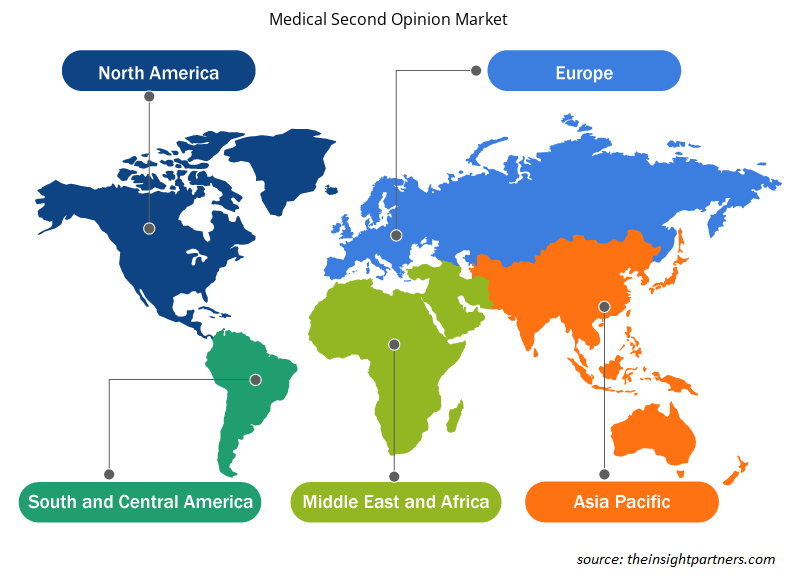
Illustration of Medical Second Opinion Market with different regions labelled (Source- theinsightpartners.com)
9. Market Competition
The medical second opinion market features a variety of service providers, each independently contributing to the industry’s development and progress. Principal participants comprise:
9.1. Extensive Healthcare Systems
Leading healthcare institutions have acknowledged the need of providing second opinion services,
incorporating them into
their patient care frameworks to improve diagnostic precision and treatment results. Prominent
instances comprise:
Cleveland Clinic: The MyConsult program offers extensive online second opinion services,
enabling patients globally to
obtain expert assessments without requiring in-person consultations.
Johns Hopkins Medicine: Esteemed for its clinical superiority, Johns Hopkins provides second opinion
consultations in
multiple specialties, guaranteeing individuals obtain knowledgeable counsel on intricate medical
issues.
9.2. Telemedicine Platforms
The emergence of digital health has led to telemedicine platforms that focus on second opinion services, enhancing the accessibility of expert consultations. Prominent platforms comprise: Teladoc Health, a leader in telemedicine, provides a range of services, including medical second opinions and facilitating connections between patients and doctors worldwide. 2nd.MD: This platform emphasises the provision of professional medical opinions, facilitating informed healthcare decisions for patients by linking them with prominent doctors. (15)
9.3. Companies Utilising AI for Diagnostics
Progressive enterprises are utilising artificial intelligence to
improve diagnostic procedures, providing data-driven
second views that augment conventional medical assessments. Illustrations encompass:
IBM Watson Health employs artificial intelligence to analyse medical data, offering evidence-based
second opinions,
especially in the field of oncology.
PathAI: Focusing on pathology, PathAI utilises machine learning to enhance diagnostic precision,
providing AI-assisted
second opinions to pathologists and doctors.
The competitive environment of the medical second opinion industry is ever changing, propelled by
technological
innovations and an increasing focus on patient-centered treatment. With the influx of healthcare
providers and
technology firms into this sector, patients are acquiring more access to a variety of options for
securing second
opinions, thereby improving the quality of healthcare delivery.
10. Prospective Growth Opportunities (2025-2030)
The medical second opinion industry is set for substantial growth from 2025 to 2030, propelled by three critical opportunities:
10.1. Expansion of Telemedicine
The extensive utilisation of telemedicine platforms offers a substantial opportunity in the medical second opinion sector. These systems facilitate virtual connections between patients and healthcare practitioners, transcending geographical limitations and improving access to expert consultations. Patients can readily obtain second views from professionals globally without travelling, resulting in expedited evaluations and possibly improved outcomes. Moreover, telemedicine enhances cost-efficiency and convenience for patients and healthcare providers, hence facilitating the growth and proliferation of the medical second opinion.
10.2. Insurance Collaborations
Partnerships between medical second opinion providers and insurance organizations can improve service accessibility and cost-effectiveness. Incorporating second opinion services into insurance plans enhances patient utilisation of these services, resulting in better healthcare outcomes and financial savings. Such collaborations can help distinguish insurance products in a competitive marketplace.
10.3. Penetration of Emerging Markets
Extending medical second opinion services into emerging markets offers a significant development potential. With the enhancement of healthcare infrastructure and the rise in awareness in these locations, there is an escalating demand for specialised medical consultations. Customising services to address the distinct requirements and cultural settings of different areas can facilitate substantial growth.
10.4. Integration of Technology
Incorporating new technologies like artificial intelligence (AI), machine learning, and blockchain
into second opinion
services can improve diagnostic precision, optimize processes, and guarantee data security. For
example, AI can
facilitate the analysis of medical records and imaging, offering early assessments that support
doctors in their
evaluations. Blockchain technology can provide secure and transparent management of patient data,
fostering trust in
digital health platforms.
By leveraging these potential prospects, stakeholders in the medical second opinion market can
optimize service
delivery, broaden their reach, and facilitate enhanced patient outcomes worldwide. (16)
11. Future Outlook
The medical second opinion market is poised for substantial growth and transformation between 2025 and 2030, driven by several key factors:
Market Growth Projections
The global medical second opinion market is expected to experience significant expansion over the forecast period. According to a report by Allied Market Research, the market size is projected to grow from $6.41 billion in 2025 to $21.36 billion by 2034, reflecting a compound annual growth rate (CAGR) of approximately 14.30%.
Technological Advancements
The integration of advanced technologies such as artificial intelligence (AI) and machine learning is anticipated to enhance diagnostic accuracy and efficiency in the medical second opinion landscape. These technologies can assist healthcare professionals in analyzing complex medical data, leading to more informed decision-making and personalized treatment plans.
Telemedicine Expansion
The proliferation of telemedicine platforms is expected to make medical second opinions more accessible to patients worldwide. Virtual consultations allow individuals to seek expert opinions without geographical constraints, thereby improving healthcare accessibility and convenience.
Patient-Centric Healthcare Models
There is a growing emphasis on patient empowerment and involvement in healthcare decisions. As patients become more proactive in seeking comprehensive information about their health conditions, the demand for second opinions is likely to increase, fostering a more patient-centric healthcare environment. (17) (17)
Investment and Innovation
The market is attracting significant investments aimed at developing innovative solutions to meet
the evolving needs of
patients. This influx of capital is expected to drive the creation of new platforms and services
that facilitate
efficient and accurate second opinion consultations.
In summary, the period from 2025 to 2030 is expected to witness robust growth in the medical second
opinion market,
propelled by technological advancements, the expansion of telemedicine, a shift towards
patient-centered care, and
increased investment in innovative healthcare solutions.
12. Conclusion:
The medical second opinion market is becoming a crucial element of contemporary healthcare systems, providing patients the chance to validate diagnoses, investigate alternative treatment options, and make educated health decisions. This approach promotes patient confidence and contributes to improved healthcare results.
Essential Insights:
Rising Demand: Patients are increasingly pursuing second opinions, motivated by the need for precise
diagnoses and
effective treatment strategies. This demand is exacerbated by escalating healthcare expenses and the
widespread
occurrence of chronic illnesses.
Technological Advancements: The incorporation of telemedicine and digital health platforms has
facilitated the
accessibility of second opinions, enabling patients to consult professionals remotely. This
technological transition has
broadened the global accessibility of second opinion services.
The medical second opinion market is anticipated to undergo considerable expansion in the
forthcoming years, with
projections suggesting large rises in both market size and value.
The medical second opinion market is essential for empowering people, improving healthcare quality,
and optimizing
treatment outcomes. With increasing awareness and emerging technological breakthroughs, the
integration of second
opinion services is anticipated to become a fundamental aspect of patient-centered healthcare
strategy.
13. References:
- Weyerstraß J, Prediger B, Neugebauer E, Pieper D. Results of a patient-oriented second opinion program in Germany: high discrepancy between initial therapy recommendation and second opinion. BMC Health Serv Res. 2020 Mar 20;20(1):237. doi: 10.1186/s12913-020-5060-7. PMID: 32192450; PMCID: PMC7083019.
- Yale Medicine. Can a second opinion make a difference? [Internet]. New Haven (CT): Yale Medicine; [cited 2025 Mar 4]. Available from: https://www.yalemedicine.org/news/second-opinions
- Coherent Market Insights. Medical second opinion market size to worth USD 20.45 Bn by 2031 [Internet]. [Place of publication]: Coherent Market Insights; [Publication year] [cited 2025 Mar 4]. Available from: https://coherentmarketinsights.com
- UserTesting. Consumer perceptions of AI in healthcare [Internet]. [Place of publication]: UserTesting; [Publication year] [cited 2025 Mar 4]. Available from: https://www.usertesting.com/resources/reports/consumer-perceptions-ai-healthcare
- A boy saw 17 doctors over 3 years for chronic pain. ChatGPT found the diagnosis [Internet]. Today; [Publication year] [cited 2025 Mar 4]. Available from: https://www.today.com/health/mom-chatgpt-diagnosis-pain-rcna101843
- Coherent Market Insights. Medical second opinion market size and trends [Internet]. [Place of publication]: Coherent Market Insights; [Publication year] [cited 2025 Mar 4]. Available from: https://www.coherentmarketinsights.com/industry-reports/medical-second-opinion-market
- Uscher-Pines L, Mulcahy A, Cowling D, Hunter G, Burns R, Mehrotra A. Access and quality of care in direct-to-consumer telemedicine. Telemedicine and e-Health. 2016 Apr 1;22(4):282-7.
- The pivotal role of telehealth technology in risk management and risk response strategies [Internet]. Int J Trends Optim Pract. [Publication year] [cited 2025 Mar 4]. Available from: https://journals.gaftim.com/index.php/itjotp/article/view/399
- 2nd.MD. Trust 1000 [Internet]. [Place of publication]: 2nd.MD; [Publication year] [cited 2025 Mar 4]. Available from: https://www.2nd.md/Trust/1000
- Second opinions improve healthcare outcomes and reduce costs [Internet]. BenefitsPRO; [Publication year] [cited 2025 Mar 4]. Available from: https://www.benefitnews.com/advisers/opinion/second-opinions-improve-healthcare-outcomes-and-reduce-costs
- Srivastava R. In an era of remarkable cancer advances, getting a second opinion can help guide choices and provide valuable reassurance. The Guardian [Internet]. 2024 Nov 6 [cited 2025 Mar 4]. Available from: https://www.theguardian.com/commentisfree/2024/nov/06/cancer-getting-a-second-opinion
- Allied Market Research. Medical second opinion market size, share, competitive landscape and trend analysis report, by disorder type and by service provider type: global opportunity analysis and industry forecast, 2023–2032 [Internet]. [cited 2025 Mar 4]. Available from: https://www.alliedmarketresearch.com/medical-second-opinion-market-A12295
- Coherent Market Insights. Medical second opinion market size and share analysis—growth trends and forecasts (2025–2032) [Internet]. 2025 Feb [cited 2025 Mar 4]. Available from: https://www.coherentmarketinsights.com/industry-reports/medical-second-opinion-market
- The Insight Partners. Medical second opinion market size and forecast (2021–2031) [Internet]. [cited 2025 Mar 4]. Available from: https://www.theinsightpartners.com/reports/medical-second-opinion-market
- Market Research Future. Medical second opinion market size, share, trends 2034 [Internet]. 2025 Mar [cited 2025 Mar 4]. Available from: https://www.marketresearchfuture.com/reports/medical-second-opinion-market-9701
- Statistics Market Research Consulting. Medical second opinion market forecasts to 2030 – global analysis by service type, disease type, pricing model, end user, and geography [Internet]. 2024 Mar 3 [cited 2025 Mar 4].
- LP Information. Global medical second opinion services market growth (status and outlook) 2024–2030 [Internet]. Dallas (TX): Orbis Research; 2024 Jan 26 [cited 2025 Mar 4]. Available from: https://www.orbisresearch.com/reports/index/global-medical-second-opinion-services-market-growth-status-and-outlook-2024-2030